How Loud Is Too Loud? Headphone Volume Safety Guide
Updated Jan 29, 2026 • 6 min read
We live in a world plugged in. From commuting to work with a podcast, focusing in an open office with lo-fi beats, to winding down with a high-energy playlist at the gym, headphones have become an extension of our ears. But this constant connectivity comes with a hidden cost: a silent epidemic of Noise-Induced Hearing Loss (NIHL).
It's easy to assume that if the music doesn't hurt, it's safe. However, hearing damage is often cumulative and insidious. It doesn't happen overnight; it creeps up after years of daily exposure to levels that are just slightly "too loud." By the time you notice you're asking people to repeat themselves, the damage is often permanent.
So, the million-dollar question is: How loud is too loud? To answer this, we need to understand not just volume, but the relationship between intensity and time.
Understanding the Decibel Scale
Sound is measured in decibels (dB). The most important thing to remember about the decibel scale is that it is logarithmic, not linear. This means that 80 dB is not just "a little bit" louder than 70 dB—it represents a significant increase in sound intensity.
To give you a frame of reference, let's look at some common sounds you encounter daily:
- 0 dB: The threshold of human hearing (near total silence).
- 40 dB: A quiet library or a whispering stream.
- 60 dB: Normal conversation. This is a safe baseline.
- 85 dB: Heavy city traffic or a noisy food blender. This is the critical threshold where prolonged exposure begins to cause damage.
- 100 dB: A motorcycle engine or a nightclub. Many headphones at max volume can easily reach or exceed this level.
- 110-120 dB: A rock concert or a chainsaw.
- 130 dB: A jet engine taking off. This is the "pain threshold" for most people.
While 130 dB causes immediate pain, damage can occur at much lower levels without any physical sensation of pain. This is why awareness is your best defense. If you're ever curious about the noise levels in your current environment—say, a noisy cafe or your office—you can use our Online Sound Meter to get a real-time reading directly from your browser.
The "Safe" Limits: Why Time Matters
The danger of sound isn't just about how loud it is; it's about how long you listen to it. Occupational safety standards (like those from NIOSH and OSHA) use a "time-weighted average" to determine safety.
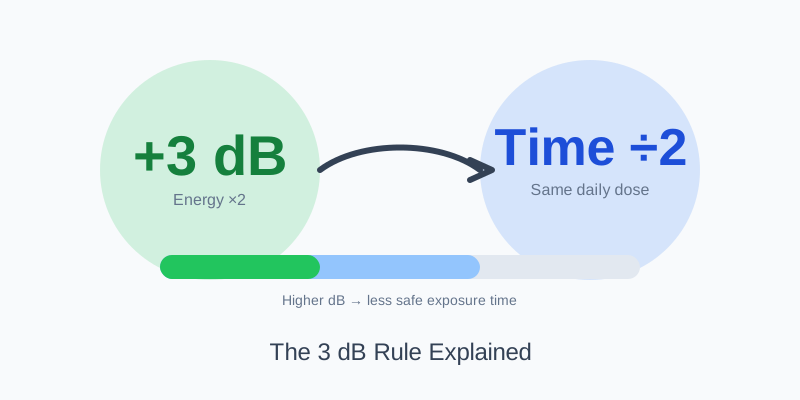
The generally accepted safe limit for continuous exposure is 85 dB for up to 8 hours. This might sound like a lot, but here is the catch: for every 3 dB increase in volume, the safe exposure time is cut in half. This is known as the "3 dB Exchange Rate."
The 3 dB Rule in Action
- 85 dB Safe for 8 hours
- 88 dB Safe for 4 hours
- 91 dB Safe for 2 hours
- 94 dB Safe for 1 hour
- 100 dB Safe for 15 minutes
Think about that for a second. If you crank your favorite song up to 100 dB (which is easily doable on most smartphones), you risk hearing damage in just 15 minutes. If you listen at that volume during a 30-minute commute, you are exceeding your daily safe "noise dose" before you even get to work.
Why Headphones Are Particularly Risky
Headphones and earbuds present a unique risk compared to speakers. With speakers, sound dissipates into the room. With headphones, the sound source is directly coupled to your ear canal, delivering acoustic energy straight to the delicate hair cells of your inner ear.
The biggest culprit, however, is the "Masking Effect." When we are in a noisy environment—like a subway train, an airplane, or a busy street—our natural inclination is to turn up the volume to drown out the background noise.
If the background noise is 80 dB (typical for a subway car) and you want to hear your music clearly, you might unconsciously boost the volume to 90 dB or 95 dB. You're not just fighting noise; you're adding to the total pressure on your ears.
Warning Signs: Is the Damage Already Done?
Because hearing loss is gradual, it's easy to miss the early warning signs. However, your ears will often give you distress signals if they have been overworked. Pay attention to these symptoms:
- Ringing in the ears (Tinnitus): A high-pitched buzzing or ringing sound after you take off your headphones is a clear sign of overexposure.
- Muffled Hearing: If the world sounds like it's underwater or "cottony" after listening to music, you are experiencing a Temporary Threshold Shift (TTS). This is your ears' way of telling you they are fatigued.
- Difficulty in Crowds: Struggling to follow a conversation in a noisy restaurant is often one of the first functional signs of high-frequency hearing loss.
If you recognize any of these signs, it's crucial to give your ears a rest immediately. If you're concerned that you might already have some degree of hearing loss, don't guess. You can take our Free Online Hearing Test right now. It generates a frequency audiogram that can help you understand your current hearing sensitivity across different pitches.
Practical Tips to Protect Your Hearing
The good news is that noise-induced hearing loss is 100% preventable. You don't have to stop listening to music; you just need to listen smarter.
1. Follow the 60/60 Rule
This is the golden rule recommended by audiologists: listen at no more than 60% of the maximum volume for no more than 60 minutes at a time. After an hour, take a 10-15 minute break to let your ears recover.
2. Invest in Noise-Canceling Headphones
Active Noise Cancellation (ANC) isn't just a fancy feature; it's a health feature. By electronically canceling out background noise (like the drone of an engine), ANC headphones lower the "noise floor." This means you can hear your music clearly at 50% volume instead of needing to crank it to 80% to compete with the environment.
3. Use Volume Limiters
Most modern smartphones have built-in safety features. On iPhone, check "Headphone Safety" in settings to reduce loud sounds automatically. Android has similar "Volume Limiter" settings. Turn these on—they are a "set it and forget it" safety net for your ears.
4. The "Arm's Length" Test
If you don't have a decibel meter handy, use this simple physical test: Hold your headphones at arm's length while music is playing. If you can hear the music clearly, it's too loud. Alternatively, if you are wearing headphones and can't hear someone speaking to you from an arm's length away, your volume is likely in the danger zone.
Conclusion
Your hearing is a precious, non-renewable resource. Once the microscopic hair cells in your inner ear are destroyed, they do not grow back. By understanding the mechanics of sound intensity and adopting simple habits like the 60/60 rule and using noise-canceling technology, you can enjoy your favorite music for a lifetime—without missing a beat.
Remember, if it's too loud, you're losing more than just the silence. You're losing the clarity of future conversations, the nuance of music, and the sounds of nature. Stay safe, listen wisely, and keep checking your environment.